Learn the Art of Their Craft
Meet SYV Maker, Fidencio Flores
We sat down with Fidencio Flores to learn more about his journey from Farming to Winemaking
Give us the quick story of your family, how they got here and what they did first.
Fidencio: My family was introduced to the U.S. through the Bracero program, a workers’ assistance program for agriculture. We came from Jalisco, Mexico—I’m Mexican and Puerto Rican, I have to stress the Puerto Rican side because my grandmother would kill me, she’s like, ‘What about us? What about me?’ In the early sixties my great-grandfather and great uncles set anchor here in Santa Ynez. He was a ranch manager, helping out for the Firestones… part of the starting crew that started planting some of the original vines. Ever since, we’ve been out there. We’ve been in the fields. We’ve been part of this growing community.
My grandfather followed his father—he’d started farming when he was eight years old—came via Chico and Santa Maria, then started to flourish. He met a beautiful woman called Betty Williams, owner of Buttonwood Farm Winery. She gave my grandfather an opportunity. She gave him a home, even got him a house in Santa Ynez, plus truck, gas card, bonuses, a great salary… and… part of the equity, so when they sold the ranch, grandpa got taken care of. He’d gone just to go translate for his uncle, but Betty said what about you?… I want you… I’m about to start a winery… This ranch needs help. I need labor. You have a community. How can we make this work?
My grandfather followed his father—he’d started farming when he was eight years old—came via Chico and Santa Maria, then started to flourish. He met a beautiful woman called Betty Williams, owner of Buttonwood Farm Winery. She gave my grandfather an opportunity. She gave him a home, even got him a house in Santa Ynez, plus truck, gas card, bonuses, a great salary… and… part of the equity, so when they sold the ranch, grandpa got taken care of. He’d gone just to go translate for his uncle, but Betty said what about you?… I want you… I’m about to start a winery… This ranch needs help. I need labor. You have a community. How can we make this work?
That relationship taught me “you need the people with the vision, and then you also need the people that help you create that vision.” From Betty: for every privilege is a responsibility… now you have the responsibility to teach this and pay this forward.
This is more than just Santa Barbara wine country. This is a family. We all need each other. We all work together. We all are part of each other’s lives. And it’s the thing that makes the Santa Ynez Valley the most beautiful thing, that you come here, you feel like family, you feel welcome. It’s funny, people when they come out from out of town, they’re like, I feel like you guys are on a script, or you guys are acting. I’m like, what do you mean? She’s like, everyone’s way too nice. Like, everyone’s way too nice here in the valley. It’s like, no, this is just how we are. I grew up in an area where everyone respects each other. We might not have the same beliefs or same mindsets but at the end of the day, we all work together to make this place beautiful.
So tell us a little bit about the meaning behind Esfuerzo and how you got started with that project.
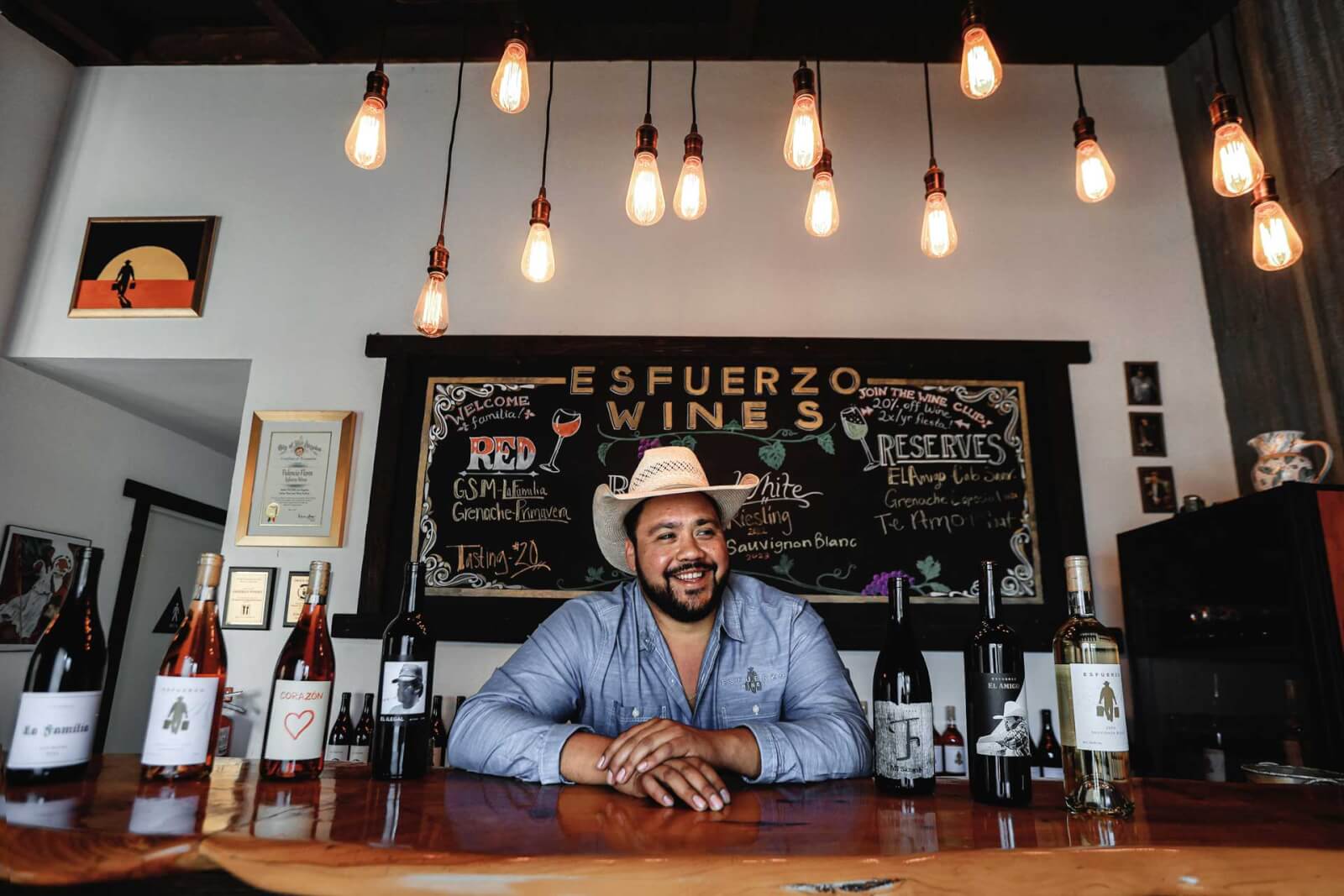
Fidencio: I grew up in a family of winemakers and farmers. I always thought, you know, I wanna do something for myself. I watched my family be part of multiple partnerships and, and great, um, great groups of people. But I was like, we’ve always been behind the vine. Now I wanna put my father in front of the vine in front of the label. And Esfuerzo came to me my last year of college. I was really doing a lot of research in Napa, working with some friends in Napa, um, some friends that have wineries out there. And I started noting that there was these Latinos also making wine. You know, there was a lot of Latino wineries out there. And I was like, wait, why don’t we have a Latino winery in Santa Ynez? Why isn’t there a piece of my culture in Santa Ynez showing our work? We’re of this product as well. And so I was, I started looking at these brands and I looked at their stories. I’m like, Hey, I have a story like that. My family’s story is similar, but different. And that’s why I decided I wanted to start Esfuerzo. I wanna start a brand that tells my family story, but also opens up a space for the community to come enjoy and embrace this culture, our colors, our flavors, make this hybrid. Right?
The brand grew from a simple question — how can I give back? With no money coming outta college, I leaned on what my family had always done: working with the community… we create jobs… projects where we all work together. I wanted it to go farther, especially to help people with their education, so I used wine; at Buttonwood we were always donating, and my mom would say I donate more wine than I sell. For me, that’s my way of being able to give back… to be at the table and… share my love and my passion… and… create a change. The brand couples community… the love of the wine, the art with my roles in the farming side of the business and behind the bar — I wanna be the maker… and that’s really how I got to starting the brand.
And Esfuerzo, if you guys know a little Latin, it’s Latin for effort, hard work. And really, this word came from a saying that my grandmother had. [Spanish here] She said, it’s almost like a blessing that she gives all her grandkids. And I said, aha, what’s something that embodies my family, my community, what we do. Effort. Day in, day out, it starts with effort, one foot in front of the other. And I said, this is it. I said, Esfuerzo is what we do, Esfuerzo is what we are. So I started Esfuerzo wines.
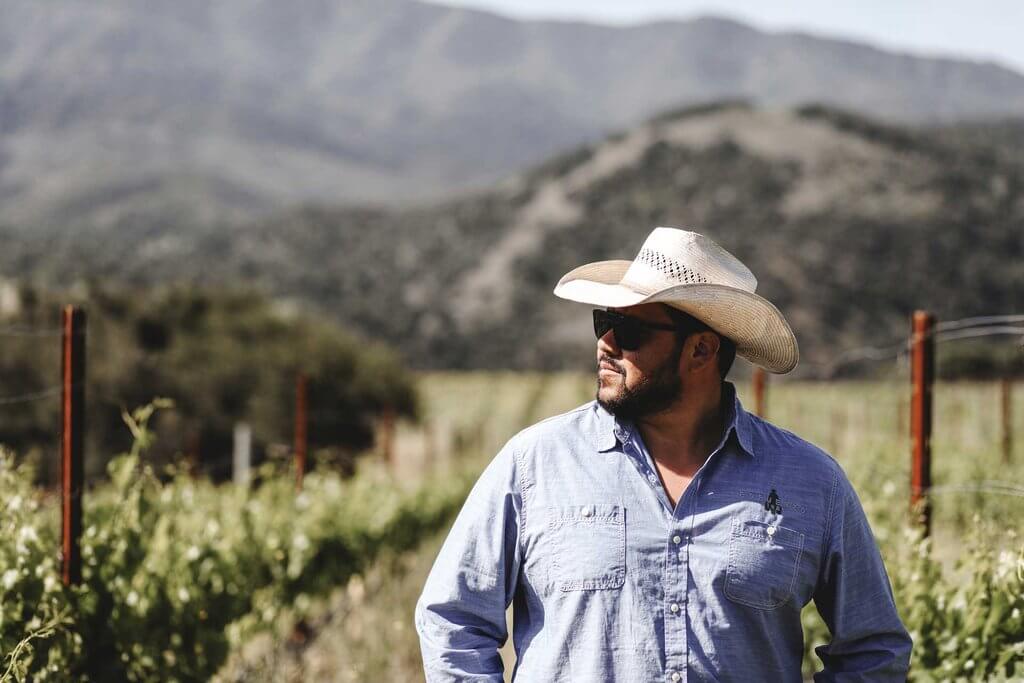
Small batch, very small batch, minimal intervention, farmed everything by hand, organically farmed. I only work with organically farmed and certified vineyards. It’s very important for me. I come from the land. I wanna leave the land in a better shape than when I had it in my hands. So then future generations can enjoy it as well. And also working with my grandfather, we’ve always just done organic. People think that this organic biodynamic thing’s like something new. This is the way that we’ve been farming for generations. My my grandfather used to be like, Hey, you see the full moon on the descending moon? That gravity’s gonna help push the water. Let’s irrigate, let’s do this, let’s do that. And that’s how I grew up farming. And then, you know, now you hear like this, all the cool biodynamic words. It’s like, this is nothing new. This is what we’ve been doing hundreds of years. It’s farming by observation, farming really being in tune with the land. And I think that’s what, that’s what’s been lost, is a lot of people just wanna play, uh, press play and have like this secret recipe and just not think about it and just let it ride. What we like to do is we like to be in tune with the land. We like to treat everything individually, uniquely.
So how do you do that? You’re both a farmer and a winemaker now, and when did you start Esfuerzo?
Fidencio: I did my first barrel in 2015 when I got outta college — one barrel of Syrah. Each year I slowly progressed to add a few more barrels, eventually over 18 barrels… this small passion project is turning into a job now. I made small batches, I’d make something, it’d be gone; I’d make something else, it’d be gone — so I saw there was a need for my wines, and a community that enjoyed them. I got fully licensed; then COVID hit, and I told myself, if I can make it through COVID, that’s a testament that we’re gonna be all right.
It was once again community-based, the word of mouth. My wine-club familia reached out. … More of my familia checked in on me than actual real family. You really do create a family; you don’t have to be biological to be family. They were the cause of us being able to survive COVID, and it gave my brand an organic boost.
So how, what’s your typical day look like? So how do you do both farming and wine making? Or do you feel like it’s pretty, um, symbiotic?
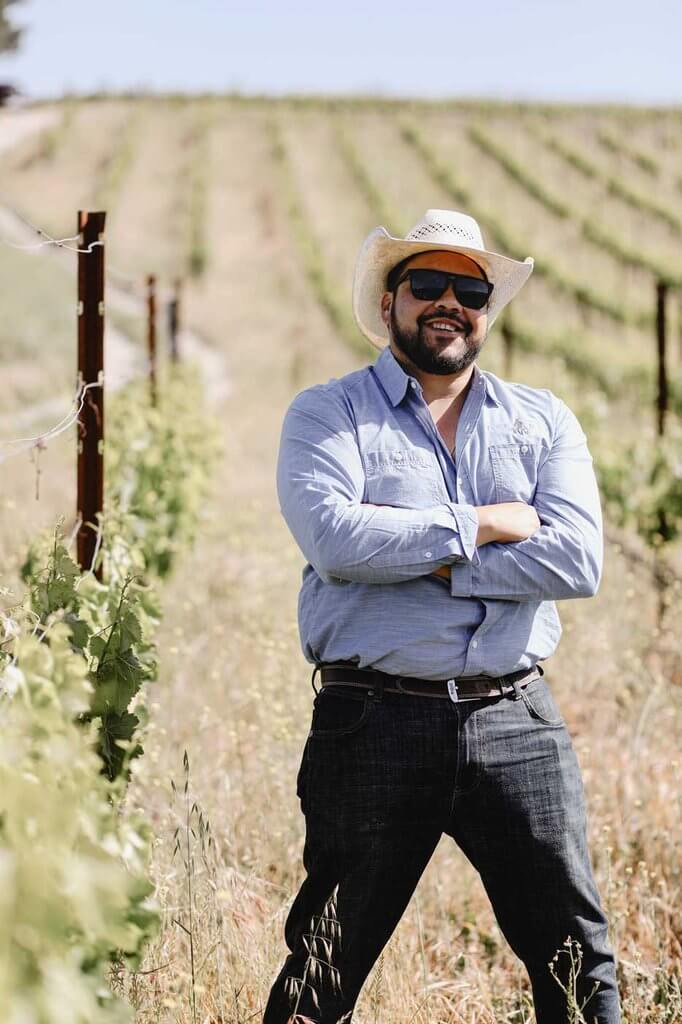
Fidencio: I treat farming and winemaking as one and the same. I’m a farmer first; the wines are made in the vineyard. If I bring in healthy, best-quality fruit, the wines should make themselves with an easy, healthy ferment and we end up with a beautiful product. I’m a farmer-winemaker who also does ag construction—a little of everything—and it all goes back to family. My grandfather, father, sister, mother, aunts, and cousins all work with me as a unit. I can’t stay out of the vineyard or the dirt—it’s what I love.
My day starts early: I check emails and texts, I’m out the door by 6:30, at the first site by 7, and I’ve checked vineyards and projects by 11 before grabbing a quick meal and coffee. I usually have meetings until 2 pm, do some winery work and check-ins, then head back to the field after 4 to catch a sunset. From sunrise to sundown I’m moving—across the valley, down to LA for tastings, or harvesting at 3 am. It’s a lifestyle—demanding and a little crazy—but it’s beautiful work that keeps me in tune with the land and lets me create something real.
Do you have any words of wisdom for someone who might want to make their own wine or start a brand?
Fidencio: For me, being a maker, it’s a big responsibility. Not a lot of people can be a maker. It takes a lot of grit, a lot of passion, a lot of heart. But being a maker for me is being part of the community. It’s sharing a passion, creating something out of nothing. For me, that’s what being a maker is. Having the ability and having the courage to make something outta nothing, and put yourself out there and share it with the world.
It’s scary. One of the scariest things you can do is start a business. Be a maker. But if you’re crazy enough like us, you’ll do it. You’ll love it, and it’ll work. You just have to believe in yourself and believe in your product. But just know that you also have to believe in your community because your community is going to be the one that’s going make the product.
You know I can make all these wines have all this fun, but if I don’t sell it, if I don’t create a connection, it doesn’t matter.
…
Q: Are there any makers that have been particularly inspiring to you in this region?
Fidencio: There’s too many to name. This whole community has been inspiring. Santa Barbara County wine community there’s no other place in the world. People here allow you to express yourself to share what you love.…
Q: What’s the first wine you’ve ever had and are there wines you like best?
Fidencio: The first wine I ever had, and one that I hold very close to my heart is Sauv Blanc. It was Betty Williams’ favorite wine. She would have a bottle every day. And I remember when I was 12 years old, I finally felt that I was grown. And she said, Fidencio, come sit. We’re gonna read a book. She’s like, pour me a glass of sauv blanc. Pour yourself some as well. So I poured a little bit and she’s like, now, throw a splash of water in it. So that’s how I started drinking wine.
That’s how I started drinking wine very young. But Sauv Blanc definitely has a place in my heart because she was a great mentor. And we always had Sauv Blanc.
I farm Sauv Blanc, Pinot, Chardonnay, Cabernet, Merlot, Mourvedre, you name it. I probably farm it, Sangiovese. I’m very fortunate to be able to cultivate many parts of the Santa Ynez Valley and work with very unique sites where I can literally cherry pick the best fruits that I want to create my wines.
My favorites to farm, our Sauv Blanc and a Cab. I love a good lush Cab, fruity, you know, just nice fruit, dark fruits. But I can’t be biased. I love ‘em all. I say I don’t have a girlfriend, but I have thousands of vines, and they’re all my girlfriends.
Q: Are there wines that you thought you would really enjoy making and have been a pain? Tell me about how they behave in the cellar.
Fidencio: Syrah, it’s a forgiving grape to farm. But when you’re making, it can be a little temperamental. Early on in the winemaking stage of Syrah, they tend to be a little grippy. Sometimes they’ll have a little heavy on the tannins. Syrah is one that you really have to work with and give it time. And once you give it time, it shows off.
That’s one of the things I really enjoy working with here in the Santa Valley. Pinot, of course, she’s a delicate flower. A beautiful grape, very thin skin, but a little bit more difficult to harness in the winery as well, because acids and just overall winemaking. It’s a little more delicate.
What challenges and rewards have you encountered on your journey
Fidencio: You know, um, in this business of farming and winemaking, there’s so many variables that you can’t control. So there’s a challenge every day. I like to say, “I plan for the year. I look out at the month, think about the week, but act on the day,” because everything’s changing. A pipe breaks, whatever there may be. Or, you know, heat wave, there’s always something changing. It’s farming, right?
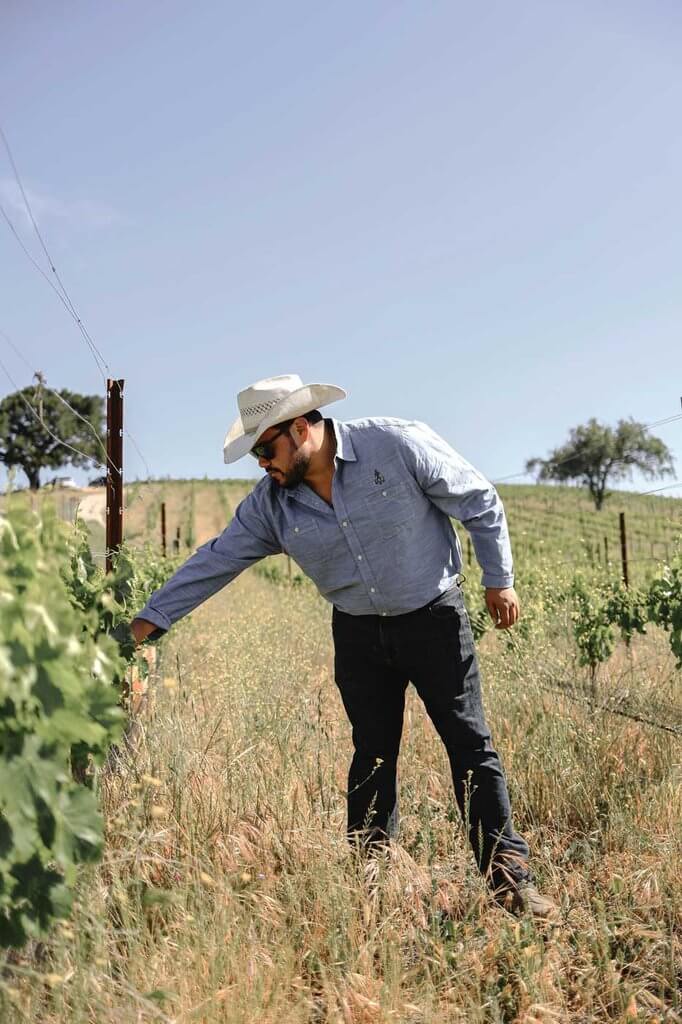
I face two sets of challenges in farming and winemaking: the environment—mother nature—and the market of selling wine. I’m constantly answering who my target audience is, what makes my wine different, why someone should visit, and why they should join the wine club.
My biggest ongoing challenge is finding the sweet spot as we grow. I don’t want to overproduce, and I only want to produce quality. If there’s a barrel I don’t like, I don’t release it—my dad might say it tastes great, but I want amazing. I’m my own toughest critic, so I have to step back and listen; it’s not just what I think or want, it’s what people want. I’m lucky to have a good family that helps me push through all of it.
How does your family see you?
Fidencio: My mother thought I was crazy… But once they started seeing the community that I was creating and what I was doing, everyone’s all in.
Mom was here setting up flowers this weekend. Dad was making sure that everything was set outside. Dad’s constantly calling me up midday, Hey, do you need anything? Grandpa, first man to call me in the morning is grandpa at 7am — “mijo, what are we doing today?” My grandpa’s like, “I like this. I like how the table’s turned. Now you pay me.”
I’m proud that I can have my whole family work for me. That they don’t work for anyone else now. They work for themselves. They work for our selves. They’re working for our dreams, but most importantly, they’re backing me up. They’re working for my vision, for this vision that I created, that I’m creating for all of us.
I was telling my dad the other day, we were driving around the valley, checking our vineyards. I’m like, dude, I just wanna say I’m, I’m so grateful to have you in my life. … He is like, I wouldn’t wanna do anything else than be riding along with my son, working on projects side by side with him. He’s like, we follow you and we’re behind you because we believe in you and you’ve taken the torch and you’re the leader.
I’m thankful for every day that I’m given because I get to do what I love in the valley that I love with the people that I love. It’s just, it doesn’t get much better than that. You know, this community is, it’s hard to find. Find me somewhere else like the Santa Ynez Valley. That’s tough. This is the golden elbow, as I like to call it.
Give me the big picture perspective as a Latino farming family with a brand?
We were the only family that, in the sense for at these places, you know, you have Feliz Noche, you have Ruben Solarzano. There’s a few of us that are out there, but not a lot of us. So for me it was that, it was like: Hey, we need representation, we also have a story that’s unique to the area and it’s native. We’re as, as local as it gets.
So Sabor de la Valle was something that I wanted to create for the community. I wanted to bring the cultures, the flavors, the colors, the music together with the thing that I love, which is wine.
And so I did my research on that. I found that we had a few here in the valley. We got Final Girl, we got Reuben Solarzano, we got Feliz Noche, Bodega de Edgar… I think there were over like 20 Latino wine makers. And I said, okay, I wanna make an event where we’re putting together these Latino wine makers with Latino chefs and create a pairing, and then have musical performances. This is something that I had envisioned my whole life. I’m like, someday we’re gonna have an event here in town that’s gonna represent us.
Because you don’t hear much about Latino winemakers. It’s kind of like, yeah, we know you worked the land. We’ve worked the land for generations, but now you’re making wine. Yeah. Now we’re making wine. Why not? We’re the ones that are most intimate with the vines. I can tell you where the best grapes are. I can tell you where the best land is. I can tell you the difference in quality. So why wouldn’t I make the wine? I think that we’re the best makers. We’re the ones that are working day in, day out with the vines. I know where the good spots are. And I think that farming and winemaking is one and the same. So I feel that the best wine makers are the ones that start in the field. The ones that understand the field, that understand the vine, that understand the language because then they can transpose that into the bottle.
Wine doesn’t have borders. It doesn’t have boundaries. Wine’s a universal language that I think is one of the most beautiful languages because when, when you sit with a glass of wine, you create a memory. And for me, it’s that connection. Now wine is connecting our communities.
How you tie it in with the Latino culture as far as food goes?
Fidencio: People are like, I never knew wine went with Mexican food. It’s like, it’s food. Wine goes with food. It doesn’t matter if it’s Mexican, Italian, French, it’s food. Our flavors are very, I mean, if you look at the palette of flavors on everyone’s cuisines, they all share or steal a little bit from everyone. For me, it’s been really enjoyable to do taco pairings — a nice shrimp taco or fish taco, with Sauvignon blanc. I like a little Rosé with some spicy Thai food or some spicy ceviche. I love a good asada ranchera with a nice Cab.
Let’s say I’m having a Birria or I’m having a mole — lighter wines, Grenaches, red blends —because you don’t want it to overtake the flavors or the spices.
It’s your day off in the Santa Ynez Valley. What do you do?
I like to ride horses. Go pick a ranch, go ride. I enjoy riding horses. I enjoy going on hikes. I love just the beauty of the valley once again. But I also like to go wine tasting. So I guess it’s not a day off. But like, I don’t know. I don’t really work. This isn’t work, I do what I love every day. Go frolic in the vineyards, check on the projects, maybe sweat a little bit, go work on my wines, go meet some cool people. Like am I really working? I guess.
As a kid, I did a lot of organic farming, a lot of row crop farming over at Buttonwood. My first client was Hitching Post, Alisal Guest Ranch, SY Kitchen, Chef Budi. Hey, what, what specialty crops can I grow for you? Some sto peppers. What about edible flowers? The Flores family, we were the anchor farm that they worked with.
What ties all makers together?
Passion. Passion and a dream. All makers have a dream. This valley, the Santa Ynez valley makers, this community that I get to work side by side with, they’re unbelievable people. They’re people that you don’t find any other place in the world. You gotta come here to meet us and to see these genuine people and see their art, be transposed into something that you can drink, eat, feel, enjoy.
We’re crazy dreamers with a passion, but we’re also a small, mighty community that executes. I like to say we’re a small town with a big heart.
Can you tell me a little bit about your logo?
My logo for Esfuerzo, for effort wines, is my father. It’s him carrying two buckets of grapes as a silhouette out in the vineyard. That was one of the harvests that I shared with him at Buttonwood. But it embodies everything that we are. I’m a child of the dirt. And we come from the earth and that’s why I wanted to incorporate my father, not only because he is my father, but also my right hand man and one of my, my biggest cheerleaders and my mentor.
Everyone that walks in just has this connection, like, oh, that reminds me of my grandfather, reminds me of my father, reminds me back in the day when I used to be out in the fields with my dad carrying, buckets of strawberries or whatever it may be. So it’s very powerful.
Do you have a vision of what you want to be doing say 20 years from now?
Fidencio: Retired [he laughs]. I mean, all the projects, they’re all symbiotic. We got the farming business, the landscape and construction business, the winemaking. We do a little bit of real estate, but it’s all within the same realm. They’re of the earth.
In 20 years, I hope I’m married and I have some kids, so there’ll be someone that can come behind me and take the torch.
But I hope to keep growing in the community. I hope to keep creating more spaces, more brands that really are genuine to the area and tell the story of who we are and where we come from.
I’m currently working on another project. We’re going to start a hard cider company from an old orchard near Buttonwood. There is no hard cider in the valley, and this is gonna be from an orchard that was built in 1970.
How do you see the Big Picture perspective on Mexico and US
It’s interesting right now. You look at where we come from and where we are now, and the journey that our families have made over generations. The work that we put in over generations to have a voice. I think a lot of people forget there is a symbiotic relationship with the motherland of Mexico and our country. We’re neighbors. We share a little line, but we’re all still one. Because we all need each other.
For me, having my family migrate to this area many, many years ago, I think it was the best move for them. It was a scary move. I remember talking to my grandfather, he is like, “how would you feel that if someone said, you’re going somewhere you’ve never been before? All you hear is California. You have this painted picture of what you think it looks like and what you think it’s gonna be like. And then you get there and you’re like, wow, running water, high-rise buildings. I came here with $5 in my pocket in a dream.”
We actually have a bottle called “the illegal” that bottle is a tribute to my grandfather’s 50th year of being in the United States… So he came to Solvang at a very young age, no idea where he was going to, but he landed in this beautiful valley with so much opportunity. And he took a chance and he executed.
I stand on the shoulders of my grandparents, on the shoulders of the community that’s helped me be where I am today. I can’t thank them enough because look what I’m doing. I’m getting to do what I love. I get to be a maker. And I think that’s the most beautiful thing that this country offers. That if you really want it, you can make it whatever you want it to be.
What Betty told me, communication is strength. It’s a tool. And for me, the gift to be able to communicate, the gift of education that was given to me through this community is everything. That’s what allows you make community — communication.